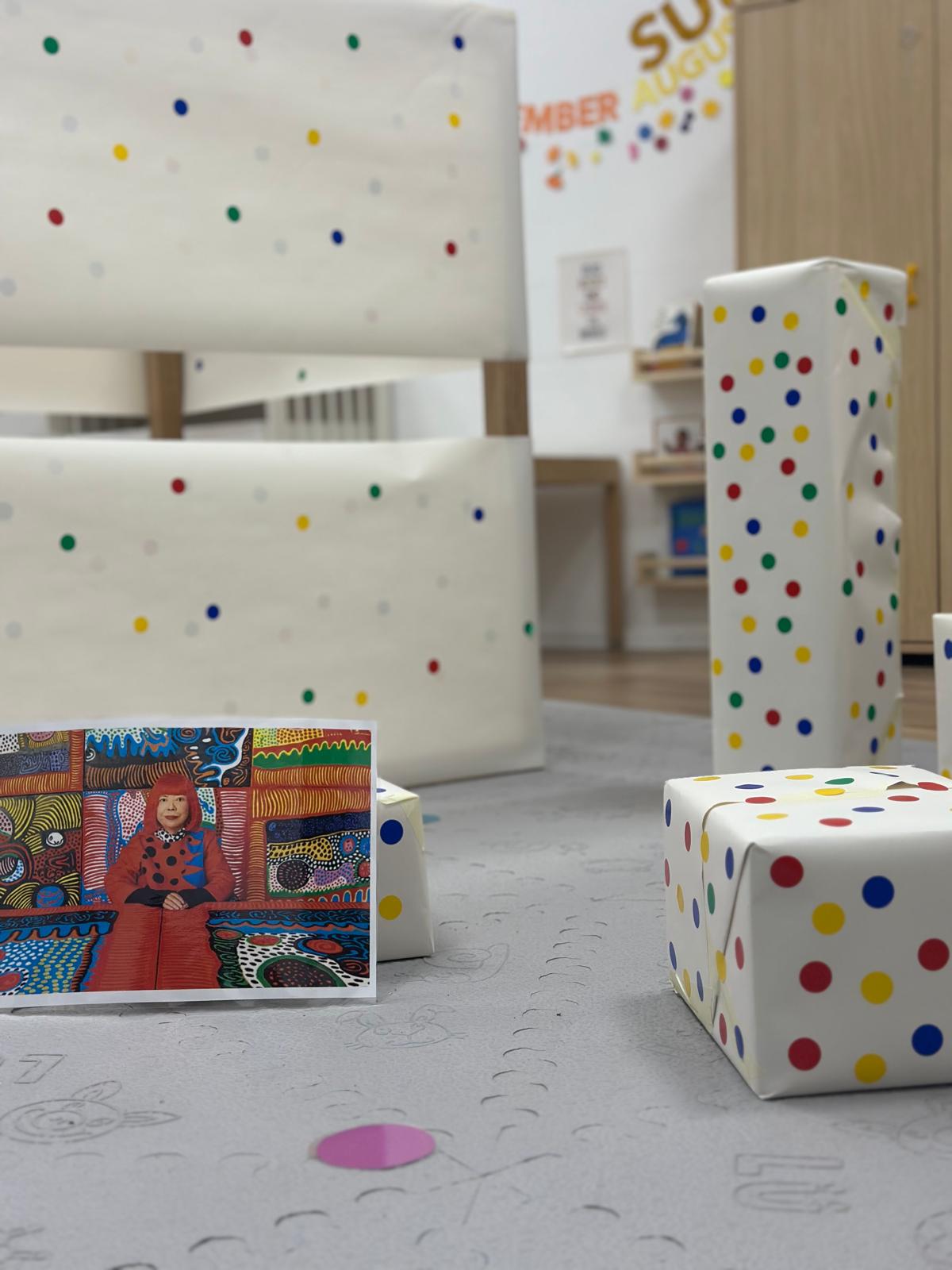
Art, the Senses and Discovery: The Yayoi Kusama Project
At Mountain Peak Montessori School, we have had the privilege of experiencing a unique artistic journey inspired by the work of Yayoi Kusama, one of the most fascinating contemporary artists of modern art. This project—designed specifically for babies in the Nido environment (from 4 to 18 months)—has been far more than a creative activity; it has been an invitation to discover the world through the senses, movement and wonder.
🎨 Who is Yayoi Kusama?
Yayoi Kusama is a Japanese artist of international renown, widely recognised for her distinctive use of polka-dot patterns and the infinite repetition of forms, which transform space into an immersive visual and emotional experience.
A Project Adapted for Babies
Traditionally, Montessori Nido environments are designed to support motor and sensory development, respecting the baby as the protagonist of their own learning within a safe, orderly and calm space.
With this in mind, our project was conceived through sensory exploration, using elements and activities inspired by Kusama’s visual universe.
Methodology: Play, Explore and Feel
Visual Discovery
Babies were stimulated with large panels of circles and repeated patterns, high-contrast dot fields and activities involving rounded shapes that capture their visual attention and support the perception of depth and colour from the earliest months.
These activities not only connect with Kusama’s aesthetic, but also respond to babies’ early visual interests, particularly their attraction to strong contrasts and simple forms.
In addition, we incorporated music and movement activities to allow babies to perceive rhythm and repetition—an essential element of Kusama’s work—through circular movement games with fabrics, soft music and free movement in colourful spaces.
Benefits of the Project
This project was not only an artistic experience, but also an opportunity for holistic development:
Sensory stimulation: Observing patterns and shapes enhances visual development and attention.
Fine and gross motor skills: Manipulating, touching and exploring objects supported bodily control and hand coordination.
Perception and curiosity: Babies learned to visually follow repetitive elements, awakening interest in their surroundings.
Emotional language: Interactions with the guides during the activities strengthened communication and emotional bonding.
The project inspired by Yayoi Kusama has been a true celebration of learning through wonder and the senses. It has shown that art is not exclusive to older children or galleries, but rather a universal language that can be experienced from the very first months of life.